


 For high performance websites and applications requiring a dedicated solution.
 Suitable for low medium traffic websites where you require complete (root) access to your server.
Fridge Sized HDD ftw!
HDDs have come a long way. They are cheaper, faster, hold more data and are much smaller than before. Today, I am going to go over the history of hard disk drives. ‘Why?’ you might ask, well why not? It is good to learn about the history of this kind of stuff, and once you know it (if you do not already) the changes will most likely fascinate those who are technologically inclined.
Let’s start with the first ever HDD. IBM produced a hard drive with a whopping 35 000 000 bits of storage in 1956. That’s about 4.4MB by the way, maybe I was building that up to be something more than it was. Anyway, this majorly undercapacitised (yes I made that word up, it means has too little capacity to store information, let’s make it a real word  ) and cost around $10 000 per megabyte. This Hard Drive was about the size of a fridge too. It contained 50 ‘two foot’ diameter disks. Since then, you are able to get hard drives that are 3TB (26 388 279 066 624 bits) and cost under $200.
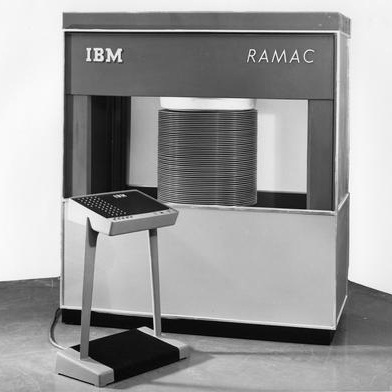
IBM's first HDD
Now, as I mentioned, the IBM HDD was $10 000 per megabyte. Now we are looking at $0.00006 per megabyte. This 142 857 142% decrease in cost per meg has taken 56 years and has allowed the computer industry to explode. Not only is the price down, but so is physical size, all the while the speed is increasing.
After this, there were other developments in shrinking the size of the technology, and in 1983 the first 3.5 inch drive was developed, a standard size used today. This drive was 10MB. There were larger capacity drives before this, such as in 1980 when IBM made the first gigabyte HDD. However these drives were expensive ($40 000) and were no smaller than the first drives ever made (fridge size).
HDD’s after this got smaller and smaller. Toshiba even had a 0.85 inch HDD that held 2.5GB of data. After the year 2006 not much changed except for capacity, with the price getting as low as $175 for 3TB. The newest development in storage technology is the world’s smallest unit of storage. IBM and the German Center for Free Electron Laser Science were able to store one byte of data on 96 atoms. Typically it takes half a billion atoms to store one byte of data! However, to do this is not easy. It’s something I will get into on another post, however it shows where storage could be heading, hard drives storing 200 to 300 times the amount of storage as they do today, which is 4 152 360 960 times as much as the first HDD!